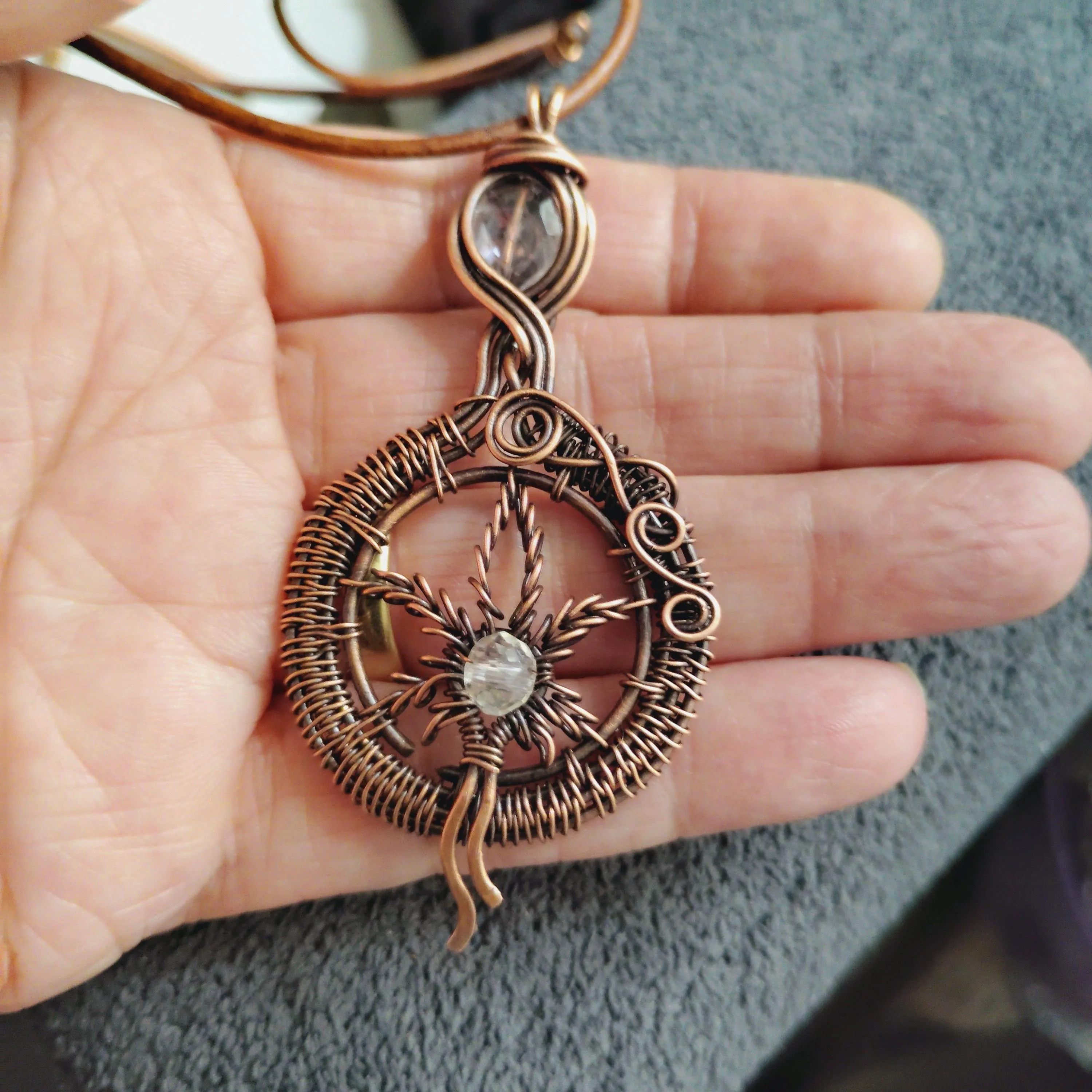
A copper pendant has two stories: the ancient story of its atoms and the human story of its shape. Long before a maker curved its wire around a stone, the material had a history that reached beyond Earth. But does that mean people cannot make copper?
The answer depends on what “make” means. People can refine copper into very pure metal, manufacture copper wire, and even produce new copper isotopes through nuclear reactions. Those are three different things. The copper used in everyday goods comes from existing material in the ground or from recycled metal, rather than being built atom by atom in a laboratory.
That distinction matters when you browse handmade copper pendants. A piece can be shaped by human hands and still contain an element with a natural, stellar origin. Neither part of that story cancels out the other.
First, what makes an atom copper?
Copper is the element with atomic number 29. That means its nucleus contains 29 protons. Its chemical symbol is Cu. Changing a piece of copper from a sheet into a wire does not change that identity. Nor does melting it and allowing it to cool into a new shape.
Atoms of one element can have different numbers of neutrons. Those versions are called isotopes. Ordinary natural copper has two stable isotopes, copper-63 and copper-65. The number refers to the total protons and neutrons in the nucleus. Both are copper, even though their masses differ. The Royal Society of Chemistry’s copper reference lists the element’s atomic number and naturally occurring isotopes.
This gives us a useful test for the word “create.” Are we changing the nucleus to produce a copper atom, separating copper from something else, or changing the form of metal we already have? Ask that first and a surprisingly tangled argument becomes much easier to follow.
Where did Earth’s copper originally come from?
The early universe supplied mainly hydrogen and helium, with small amounts of other light elements. Copper belongs to the later story of element formation in stars. NASA’s explanation of the universe’s composition describes how heavier elements arose through nuclear reactions in stars and supernova explosions.
That broad picture supports the idea that copper has cosmic roots. It does not mean a finished lump of copper wire was floating through space, or that every element followed the same route. Atoms formed through nuclear processes; the minerals, ores, and objects we recognize came later.
It also helps to separate making an element from distributing it. A star can produce material during its life, while its later explosion helps spread that material into space. The dramatic moment of death is part of the journey, but it is not automatically the moment every atom was made.
Nuclear reactions produce heavier elements through several pathways.
Enriched gas and dust become ingredients for later stars and planets.
Geology, refining, and handwork turn existing material into a wearable piece.
How do stars produce copper?
Massive stars are important contributors. One route involves neutron capture: an atomic nucleus takes in neutrons, and subsequent radioactive changes can turn it into another element. A process known as the weak s-process operates in massive stars during stages of their lives before a supernova.
The word “weak” is a technical label, not a claim that the process is unimportant. The 2010 study of the weak s-process in massive stars explores copper production and how it changes with stellar conditions and nuclear reaction data. The details matter because a star is not a furnace with a single fixed recipe.
Explosive processes matter too. A 2025 study of cobalt and copper nucleosynthesis discusses neutron capture and production in hot supernova ejecta, including a pathway called alpha-rich freeze-out. It also considers contributions from Type Ia supernovae. The balance depends on the stellar population and the models used.
For a jewelry lover, there is no need to memorize those terms. The useful point is that copper’s origin involves several nuclear pathways. “Made through the lives and deaths of stars” is a sound broad description. “Made only when one particular kind of star dies” is a much stronger claim than the evidence supports.
Does it have to be a second-generation star?
No specific generation can be assigned to all the copper around us. Stars enrich their surroundings over time, and later stars form from material that has already been changed by earlier ones. That is a shared history, rather than a clean family tree in which every atom has an identifiable parent.
Researchers compare copper abundances across different stellar populations to understand that history. A study comparing Omega Centauri with the Milky Way found that massive stars were the main contributors in its chemical-evolution models. That supports the importance of massive stars without identifying a particular ancestor for the metal in a necklace.
The phrase “second generation” can suggest more precision than we have. It should not be used as a certificate of origin for a piece of copper. We can describe the processes and the larger history while being honest that we cannot trace an ordinary piece of wire back to one named star.
How did that copper become part of Earth?
Our solar system formed about 4.6 billion years ago from a cloud of gas and dust. NASA’s account of solar-system formation explains that this cloud already included heavier elements made by earlier generations of stars. Earth inherited those ingredients as it formed.
On Earth, copper occurs in minerals and sometimes as native metal. The Geoscience Australia copper guide describes its ores, deposits, and processing. Geological activity gathers and redistributes existing copper into deposits; it is not doing the same job as stellar nuclear reactions.
Think of the distinction as origin versus location. Finding copper in a rock explains where we obtain it now. Explaining how that deposit formed tells another part of its history. Neither question is identical to asking how the copper nuclei first came into existence.
Can people make pure copper on Earth?
Yes. “Pure” describes composition, not a requirement for cosmic conditions. People obtain copper from ores and refine it to remove unwanted material. The Royal Society of Chemistry describes smelting, leaching, and electrolysis as routes used to obtain copper. Those processes work with copper that already exists.
It is a little like sorting beads from a mixed jar. Separating the beads does not create them, but the sorted result is still a real product of your work. Refining is much more involved than sorting by hand, yet the comparison helps explain why making a pure material and making its atoms are separate questions.
Remove unwanted material from existing copper.
Shape copper into wire, sheet, hardware, or jewelry.
Use nuclear reactions to produce copper isotopes.
So the claim that Earth cannot supply the energy to make pure copper confuses two levels of the story. High-purity copper does not require us to reproduce a star. It requires a suitable source of copper and a refining process. The resulting metal’s ancient atomic history remains a separate fact.
Can a laboratory actually make copper atoms?
Yes. A published study of copper-64 production using a hospital cyclotron describes making that isotope from nickel-64. This is nuclear production, rather than simply extracting copper that was already present as copper.
There is another clear example from the U.S. Department of Energy’s copper-67 program: a high-power electron beam and zinc targets are used to produce copper-67. Part of the zinc is transmuted into copper, which is then separated for specialist medical applications.
These examples are enough to rule out an absolute claim that humans cannot make copper. They do not describe how ordinary jewelry wire is supplied. Medical isotope production has a particular purpose, and radioactive copper isotopes are different from the stable natural copper used in everyday metal goods.
The important limit is practical context. Being able to produce an isotope in a specialist facility is not the same as having a sensible way to manufacture bulk jewelry metal. There is no need to exaggerate either side: the laboratory achievement is real, and so is the ancient origin of ordinary copper.
What does “man-made copper” mean in jewelry?
A shopper may use the phrase to mean a manufactured object, an imitation surface, or a material made in a laboratory. Those meanings are too different to treat as interchangeable. When looking at a listing, ask what the actual material is rather than relying on a label that could mean several things.
| Term | What it describes |
|---|---|
| Solid copper | Copper throughout the metal part, rather than a copper surface over another metal. |
| Copper-plated | A copper layer over a different underlying material. |
| Copper-colored | An appearance. The phrase alone does not identify the metal. |
| Copper alloy | A mixture containing copper and other elements, such as brass or bronze. |
The University of Arizona’s copper overview explains that copper can be drawn into wire and that brass and bronze are copper alloys. Drawing wire changes its shape. Mixing an alloy changes its composition. Neither is the same as producing new nuclei.
Handwork adds another kind of value: the choice of stone, the balance of a frame, and the time spent shaping each curve. Our approach to handmade wirework is about that human contribution. For questions about an individual piece’s materials, contact the maker before choosing.
An ancient element, a personal piece
Copper does not need an impossible claim to be remarkable. Its stellar past is fascinating, and the work that turns it into something wearable deserves its own appreciation. The science tells the material’s long story. The maker gives it a form that can become part of yours.
Explore our handmade jewelry collection to find the piece that catches your eye. Once it is yours, the copper jewelry care guide explains how to protect its wirework, stone, and finish through everyday wear.
Common questions
Copper’s origins, explained
Can humans make copper atoms?
Yes. Nuclear reactions can produce copper isotopes on Earth. That is different from the mining, refining, and recycling that supply ordinary copper metal.
Can pure copper be produced on Earth?
Yes. Refining removes other materials from existing copper. Purity describes the resulting material, not where its atoms originally formed.
Was copper made by a second-generation star?
Copper has a stellar origin, with massive stars playing an important role. It is too specific to attribute all copper to the death of a second-generation star. Stellar production involves more than one process and a long history of enrichment.
Is copper wire a man-made material?
Wire is a manufactured form of copper. Drawing metal into wire changes its shape, rather than creating its copper atoms. Check each jewelry listing to distinguish solid copper from copper plating or copper-colored materials.